
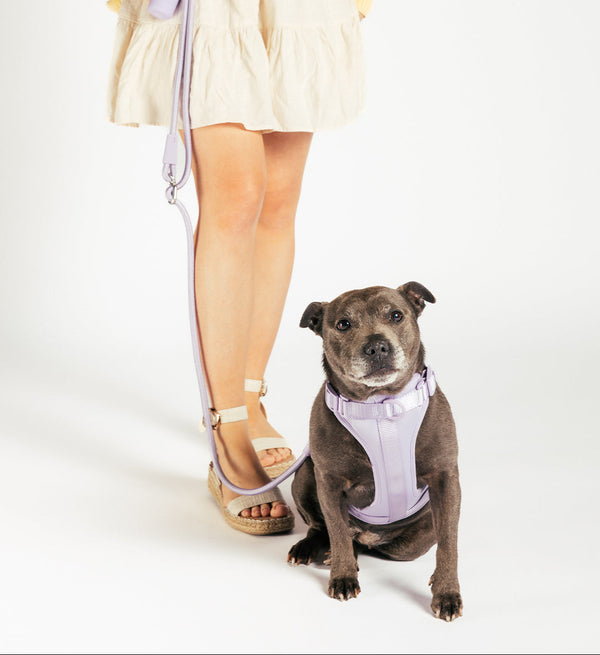
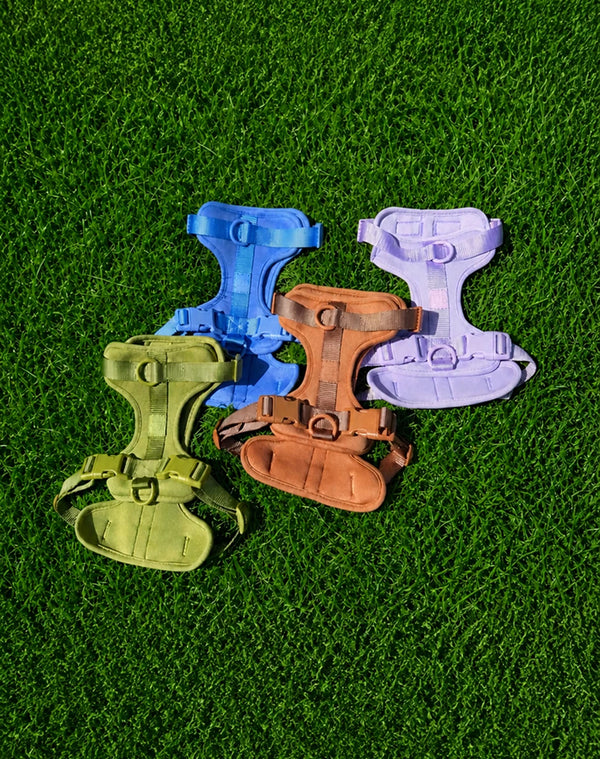
The dog harness that does not pull back.
A good harness distributes pressure over the chest, not over the trachea. We explain why that matters, and which model suits which dog.
Why a harness and not a collar?
A collar places the full pulling force on one spot: the trachea. For energetic dogs, and especially for brachycephalic breeds like Staffords, Boxers, and Bulldogs, this is no detail. It is a health risk.
A well-shaped dog harness distributes that same force across the chest and shoulders. The result: less coughing, better breathing, and a dog that can learn to stop pulling at its own pace.
The three types harness and what they do.
Not every harness does the same thing. Some are made to counter pulling behavior, others for comfort on long walks, and yet others for dogs with specific shapes. Here is how to tell them apart.
Y-harness
The Y-shape sits clear of the shoulders, perfect for free movement. Our favorite for daily use.
Anti-trek (front-clip)
An attachment point on the chest physically corrects pulling behavior. Good for training, less so for hours of walking.
Step-in
Two paws in, click it shut. Fast, but less supportive for wide chests.
Harness vs. collar: the differences.
Two fingers between harness and dog.
A good fit is about two things: it shouldn't slide under the armpits, and you should be able to fit two fingers in. If your dog turns to the side, the harness shouldn't tilt along with him. If you can't fit two fingers in anywhere, it's too tight. One finger is enough, three means your dog slips out as soon as he sees something move.
Always measure at the widest point of the chest, not the belly. And when in doubt, measure both sizes. Choosing the intermediate size is almost never right. Check our size guide for help.
Our dog harnesses


Frequently asked questions.
At what age can my puppy wear a harness?
From 8 weeks you can start letting your puppy wear one. Short, friendly, with treats. We recommend teaching pulling behavior with a harness from 4 months, when the growth plates are strong enough. Read more in our puppy harness guide.
Does your dog harness fit my Stafford?
Yes, we designed it with Pip as the model. Even with her compact body, everything fits perfectly. Size S fits most smaller Staffords, but measure just to be sure using our size guide.
Can a harness go in the washing machine?
That's not necessary. The material is waterproof, so a quick rinse under the tap is enough. Let it air dry, not in the tumble dryer.
How do I know if my dog is comfortable?
A well-fitting harness ensures a natural gait. Does your dog walk stiffly, with shoulders hunched, or is he trying to squirm backward? Then it is too tight or in the wrong place.
Join the pack.
New drops, guides, and occasionally a photo of Pip.